Book Examines the Exclusion Act
The Paper Trail offers a glimpse into early Chinese history in Canada.
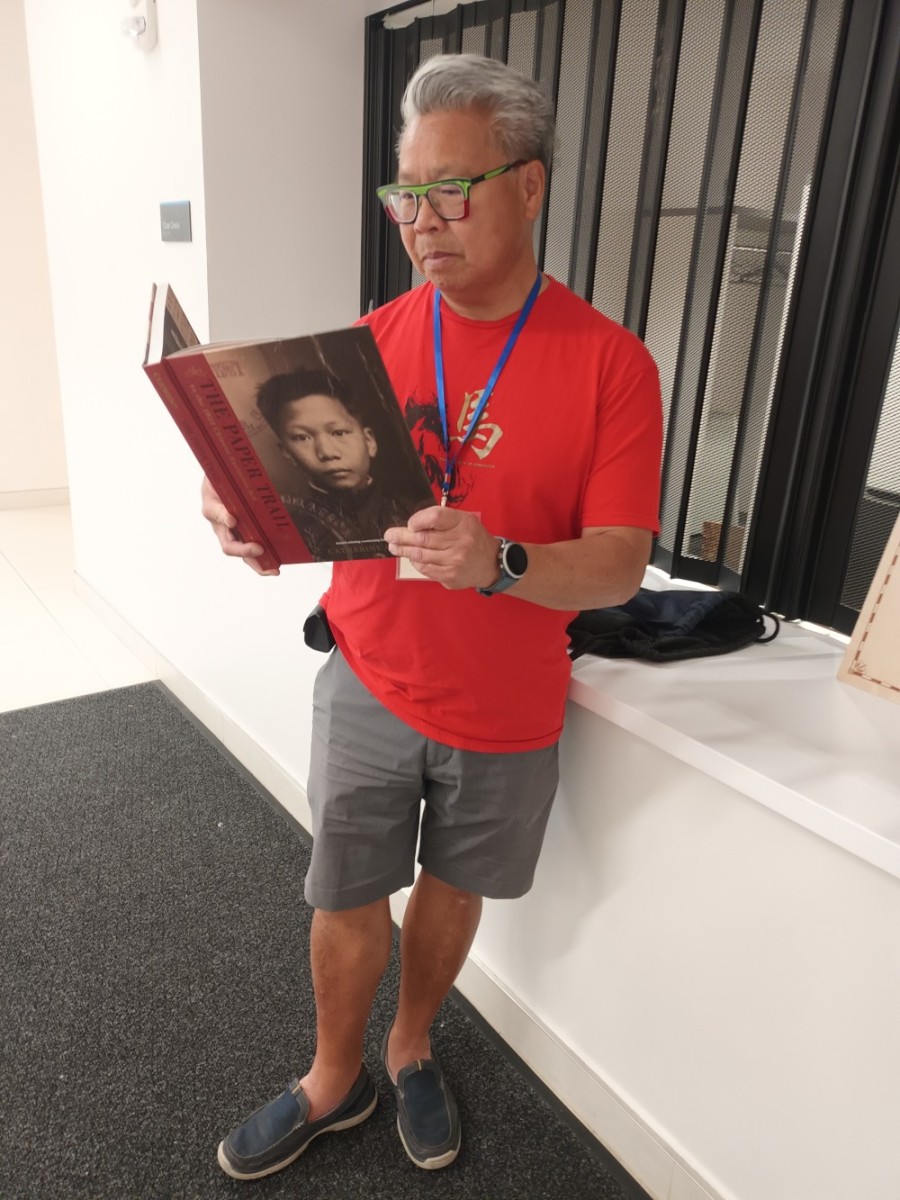
The Paper Trail to the 1923 Chinese Exclusion Act by the B.C. community historian Catherine Clement was introduced at a book launch at the Stanley Milner Library in June 2025.
The book was the culmination of research undertaken to commemorate the 100th anniversary of the Chinese Immigration Act, also referred to as the Exclusion Act. Exhibitions were mounted in several cities in 2023.Those exhibits form the basis for the book.
Clement writes, “The Exclusion Act was a monumental chapter in the origin story of Chinese in Canada. Yet as I began to reach out to families across Canada, I was astonished by how little Chinese Canadians knew about the Act or the impact it had during the quarter century it was the law."
Listening to Clement at the book launch, I learned more about the history of the Chinese Canadian community in an hour than I ever did in school.
Clement’s book serves as a historical record of the immigration policy that specifically targeted the Chinese community. One early policy was the Head Tax, imposed only on the Chinese. The $50 tax (later increased to $100 and reaching $500 in 1923) limited the ability of Chinese men to bring their families to join them in Canada.
In the run-up to the declaration of the official Chinese Immigration Act declared on July 1, 1923, Chinese residents were registered, fingerprinted, and documented. Canadian-born children were excluded from citizenship and issued a Canada Immigration document, C.I. 45, that included the declaration: "This certificate does not establish legal status in Canada.”
Featured in the book are the individual stories of Chinese immigrants who, even if educated in Canada, were unable to practise professions in medicine, law, or engineering, and their pushback to immigration policies that singled out Chinese immigrants.
In the face of the discrimination that limited access to the labour market, Chinese merchants opened restaurants, laundries, and convenience stores to make a living. (Merchants were excluded from having to pay the Head Tax.) The Canadian Prairies are still home to these Chinese restaurants in many small towns.
Clement’s book amasses the paper documents hidden in drawers and trunks of families who wanted to forget those years of the “Exclusion Act,” the unofficial name of the Chinese Immigration Act. Each chapter contains stunning photos and images of archival records.
Locally, the Mah Society of Edmonton, with lead researcher Connor Mah, participated in the gathering and scanning of artifacts housed in the Provincial Archives of Alberta and the Bruce Peel Special Collections at the University of Alberta. Excerpts and articles from community newspapers detail the debates and opinions of the day, and document some responses of the Chinese community to these draconian laws.
Particularly poignant to me was the chapter on the “uncles.” These men spent their lives as bachelors in rooming houses in our cities and towns, working as labourers, dishwashers, or field workers in agriculture. Many of these men had left their families behind, hoping to create a better life in Canada. For too many, poverty and ill health from hard physical labour, along with exclusionary immigration policies meant they would never see their families again.
As late as World War II, the Canadian-born descendants of Chinese Canadians were denied the vote, and could still not practise medicine, law, or engineering. Veterans of that war worked to get full citizen rights for Chinese Canadians. Full voting rights were finally achieved in 1947.
The Exclusion Act ended in 1947, after a quarter century.
The Harper government issued a formal apology to Chinese Canadians in 2006. “For over six decades, these malicious measures, aimed solely at the Chinese, were implemented with deliberation by the Canadian state," said the then-Prime Minister. "This was a grave injustice, and one we are morally obligated to acknowledge.”
As Canadians debate immigration policy, Temporary Foreign Worker programs, and a Conservative MP raises the question of birthright citizenship, the Paper Trail to the 1923 Chinese Exclusion Act provides an examination into Canadian history that is increasingly relevant to today’s discussions.
The book is published by Plumleaf Press and is available to order for $59.95.
For a local connection, book a visit to the The Journey of the Horse exhibit, housed at the Mah Society in Boyle Street (9643 Okisikow Way) celebrates 100 years of the Mah Clan in Edmonton. For more information, read the Boyle McCauley News story by Paula Kirman, January 2024). You can book a time to see the exhibit by clicking here.
Gail Silvius is happily retired and living in McCauley.