City Urges Residents to Report Unsecured Vacant Properties
Sites at higher risk of fire as temperatures drop.
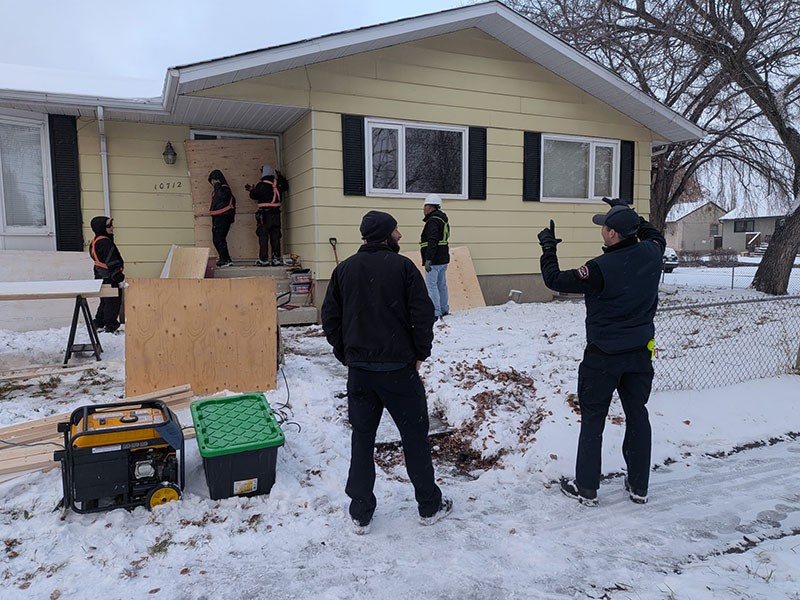
Communities have many reasons to resent problem properties. They’re unsightly. They can attract negative behaviours.
But as temperatures drop, unsecured properties can also pose a safety risk. Someone seeking relief from the cold may enter and start a fire, sometimes with tragic consequences.
That’s where the City of Edmonton’s Community Property Safety Team (CPST) comes in.
“A fire at an unsecured vacant property is a missed opportunity,” says Captain Jennifer Sikorski, who oversees the team’s operations. “If we can prevent that fire in the first place, we reduce the risk of tragedy, potential injuries to first responders, or property damage to neighbours.”
Sikorski’s team is renewing its call for citizens to report unsecured vacant properties through 311 or emailing the City at communitypropertysafetyteam@edmonton.ca. Other problem properties can be reported through 311 or confidentially at edmonton.ca/ProblemProperties.
The CPST team investigates all reported unsecured vacant properties within 48 hours, and can issue an order to the property owner to secure the property.
It isn’t just another piece of paper. If an order is ignored, the City will secure the property themselves. The costs of boarding up the property, added security fences, or even round-the-clock security patrols will be added to the owner’s property tax bill.
The model has already made an impact. CPST has directly secured 830 high-risk properties over the past four years, significantly reducing structure fires in neighbourhoods like Alberta Avenue and McCauley. CPST’s actions have also led to the demolition of nearly 45% of properties investigated by the team, permanently eliminating the risk they present.
“We’re actively monitoring around 600 sites across the city,” Sikorski says. “But we ask Edmontonians to let us know when they spot an open, vacant property, because doing so can save lives.”
CPST is one component of Edmonton’s broader Problem Property Initiative (PPI), which tackles problem properties from a variety of angles. Over the past four years, 2,600 unique residential and commercial sites have been addressed.
It’s more than fencing or boarding up homes. People who live in neglected properties are often in core housing need and struggle to afford anything else. More than 400 vulnerable tenants living at problem properties have been connected to vital support services.
Across 600 cleanups and 16 demolitions, 2.7 million pounds of debris and hazardous materials have also been removed.
“It’s making a tangible difference,” says Julianna Schulz, the Superintendent of Municipal Enforcement, who oversees the initiative. “We know how frustrating these properties can be, so it’s gratifying to see improvement.”
The PPI’s comprehensive approach builds on a close relationship with the public, which requires transparency and accountability. Schulz notes that more than 110 community meetings and events have been held, along with direct engagements with more than 12,000 Edmontonians.
As part of this ongoing work, the City has unveiled a new PPI public dashboard, which allows anyone to access key data in real-time. The dashboard – which can be accessed at gis.edmonton.ca/ppi – includes info about inspections, enforcement actions, properties cleaned up and secured. An interactive heat map also allows residents to see how specific neighbourhoods are impacted.
“Problem properties are a community issue,” says Schulz. “We want Edmontonians to know that we’ve got tools to make a difference, and that we’re always here to help.”
Information provided by the City of Edmonton.